
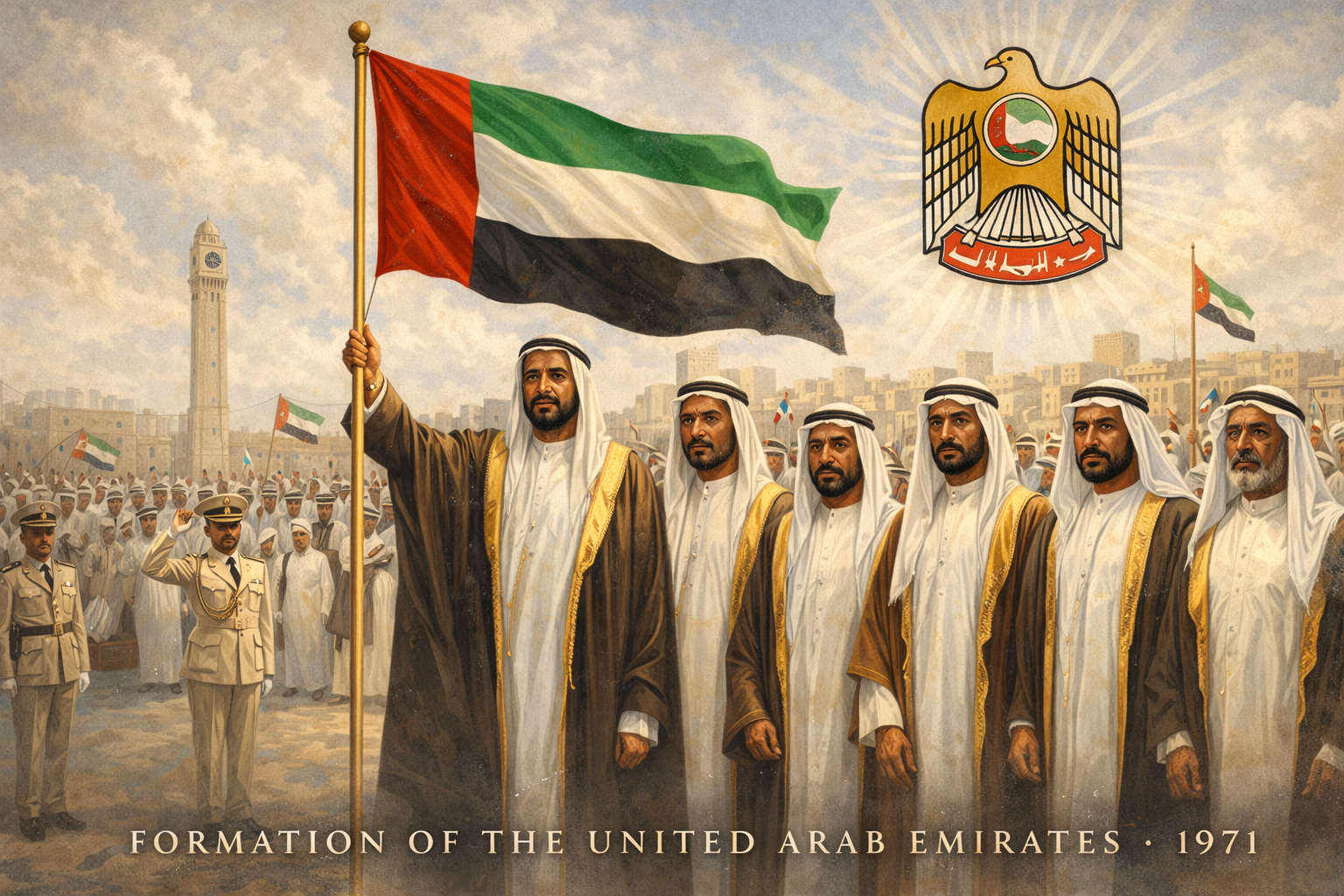
The United Arab Emirates (UAE) is one of the most successful and rapidly developing countries in the world. Known for its futuristic cities, strong economy, and rich cultural heritage, the UAE has a powerful history that dates back thousands of years. This detailed blog post explores the complete historical journey of the UAE — from ancient settlements to becoming a global leader.
Ancient Civilizations in the UAE (5000 BCE – 7th Century)
Archaeological discoveries confirm that the land of the United Arab Emirates has been inhabited for over 7,000 years.
Important archaeological sites include:
- Al Ain – A UNESCO-listed heritage city with ancient tombs and irrigation systems.
- Umm Al Nar – Known for Bronze Age tombs (2600–2000 BCE).
- Hatta – Famous for ancient mountain settlements.
During ancient times, the region was part of important trade routes connecting Mesopotamia and the Indus Valley. Copper and other goods were exported from the region.
The Pearl Diving Era (16th – Early 20th Century)
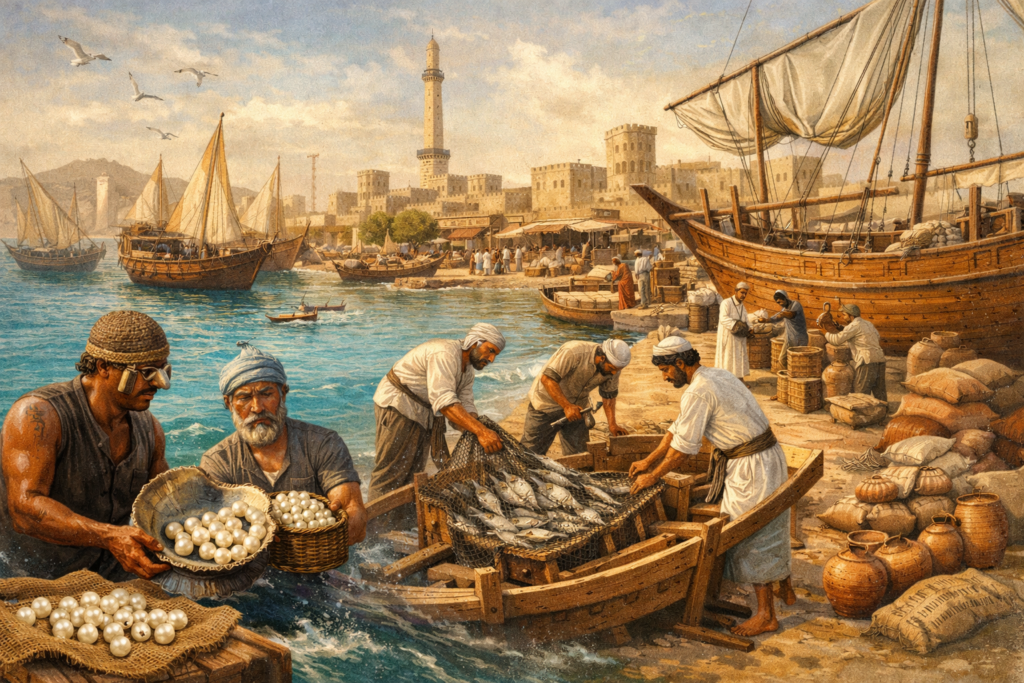
Before oil was discovered, the economy depended on:
- Pearl diving
- Fishing
- Maritime trade
- Boat building
Cities such as Dubai and Sharjah became major trading hubs in the Gulf region.
The UAE was once one of the world’s largest producers of natural pearls. However, the pearl industry declined in the 1930s due to the invention of cultured pearls and global economic changes.
The Trucial States & British Agreements (1820–1971)
In the early 19th century, Britain signed maritime treaties with local rulers to protect trade routes in the Gulf. The region became known as the “Trucial States.”
Under these agreements:
Britain handled defense and foreign affairs.
- Local rulers maintained internal governance.
This period lasted until 1971, when Britain announced its withdrawal from the Gulf.
Discovery of Oil & Economic Transformation (1950s–1960s)
Oil was first discovered in:
- Abu Dhabi (1958)
- Dubai (1966)
- Oil revenue transformed the desert region into a modern nation by funding:
- Roads and infrastructure
- Education systems
- Healthcare facilities
- Airports and ports
- This marked the beginning of rapid modernization.
Formation of the UAE (1971)
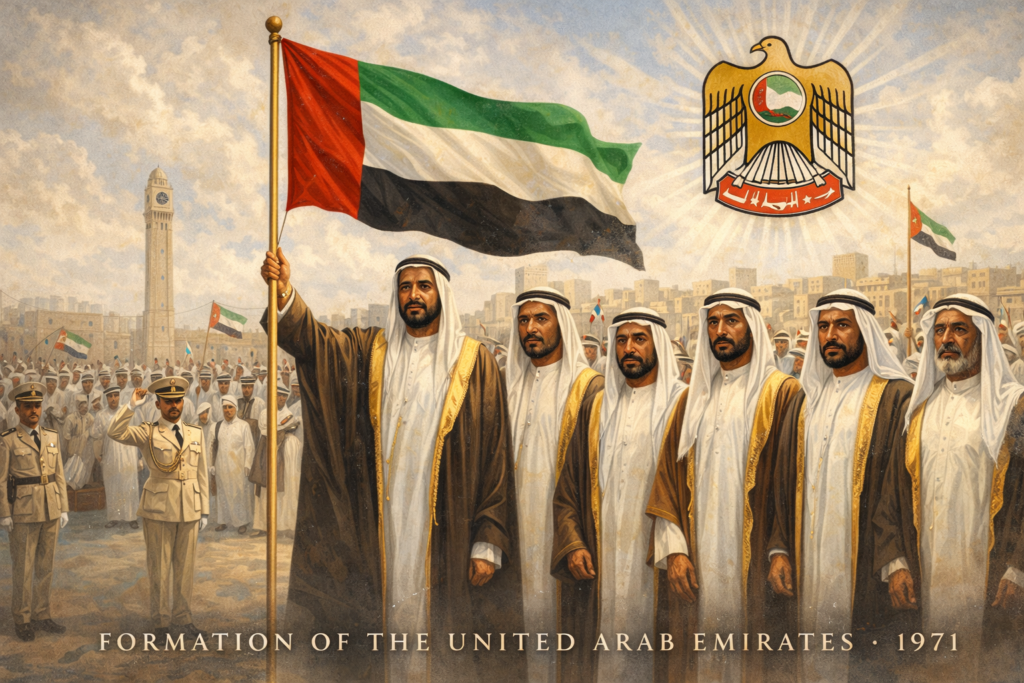
On December 2, 1971, six emirates united to form the United Arab Emirates:
- Abu Dhabi
- Dubai
- Sharjah
- Ajman
- Umm Al Quwain
- Fujairah
In 1972, Ras Al Khaimah joined the federation.
The founding father of the nation was Sheikh Zayed bin Sultan Al Nahyan, who became the first President of the UAE. His leadership played a crucial role in uniting the emirates and building the country’s foundation.
Political Structure of the UAE
The UAE is a federal constitutional monarchy consisting of seven emirates. Each emirate is ruled by its own ruler.
- The President is traditionally the ruler of Abu Dhabi.
- The Prime Minister is traditionally the ruler of Dubai.
The Modern UAE: A Global Powerhouse
Today, the UAE is known for innovation, tourism, and economic diversification.
Major achievements include:
- The construction of Burj Khalifa, the tallest building in the world.
- The launch of the UAE’s Hope Probe under the Emirates Mars Mission in 2020.
- Hosting Expo 2020 in Dubai.
The country has diversified its economy beyond oil into sectors such as aviation, finance, technology, tourism, and renewable energy.
Culture & Heritage
Despite rapid modernization, the UAE preserves its cultural traditions:
- Falconry
- Camel racing
- Traditional dance (Al Ayala)
- Arabic hospitality
Museums such as Louvre Abu Dhabi reflect the country’s commitment to cultural exchange and heritage preservation.
Key Historical Timeline
- 5000 BCE – Early settlements
- 2600 BCE – Umm Al Nar civilization
- 1820 – General Maritime Treaty
- 1958 – Oil discovery in Abu Dhabi
- December 2, 1971 – Formation of the UAE
- 1972 – Ras Al Khaimah joins